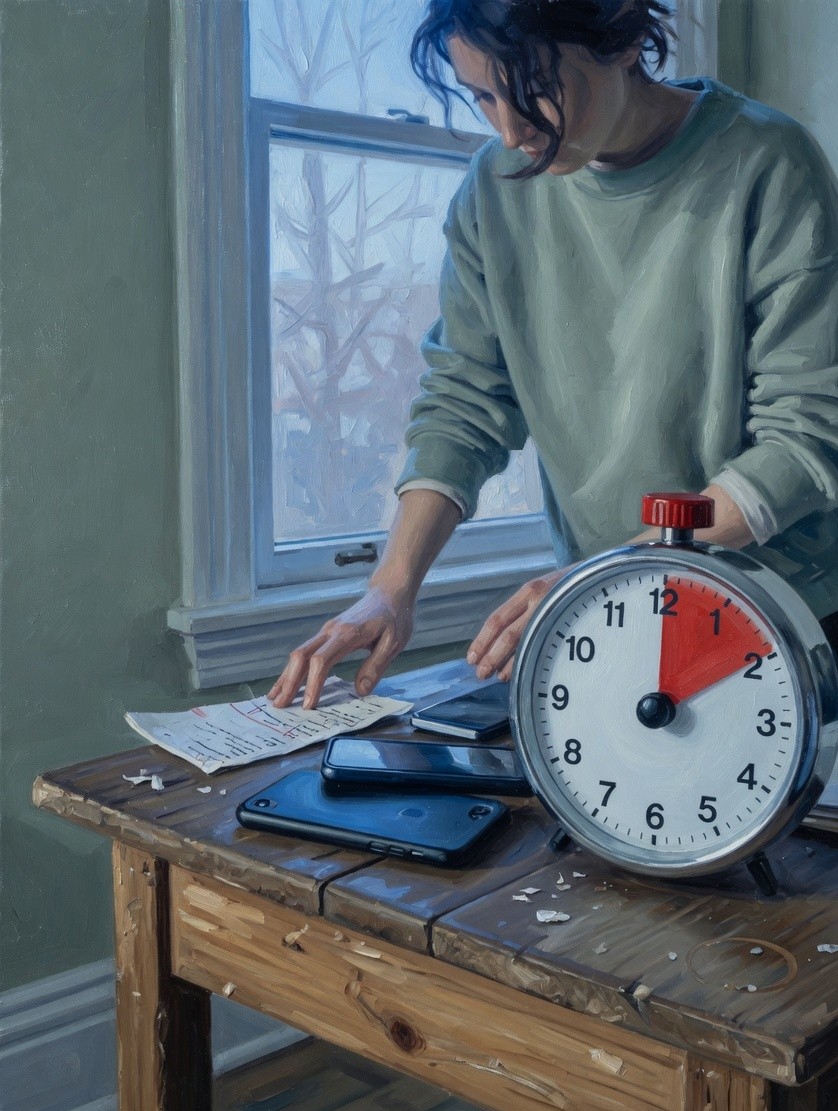
Outside your head
Attention is inconsistent, not absent. It locks onto what is interesting, urgent, or new, and it drops what is merely important. Willpower does not fix that. A system does: a calendar, a list, a timer, and a room set up so the task can survive. This page gives you ten tools, in order.
This page suits people whose attention is inconsistent, especially those with ADHD-style patterns. If attention problems impair your work, relationships, or safety, get assessed. Tools help, but they are not a substitute for care.
Start here: Tool 1 and Tool 2. Everything else depends on them.
Find your problem
| If this sounds like you | Go to |
|---|---|
| You are late, or “later” keeps vanishing | Tool 1 |
| Commitments live in your head or on scraps | Tool 2 |
| Keys, bills, and files keep disappearing | Tool 3 |
| A task is so big you never start it | Tool 4 |
| You can do fun things for hours but not dull ones | Tool 5 |
| You lose focus within minutes | Tool 6 |
| Your phone and clutter win every session | Tool 7 |
| Random thoughts derail you mid-task | Tool 8 |
| The system fails on bad sleep | Tool 9 |
| The system worked, then you dropped it | Tool 10 |
Why attention leaks
Three forces explain most of the pattern.
Interest beats importance. What you attend to becomes brighter and more real. What you ignore fades. Phones and feeds are built to grab that beam. You are outgunned by design.
Time collapses into “now” and “not now.” Later has no weight until it becomes an emergency. That is why a deadline produces focus that three weeks of “I should start” did not.
Working memory is small. Working memory is the mental scratchpad that holds what you are doing. It drops when a ping arrives or when you change rooms. So the system must live outside your skull.
Tool 1: Put time outside your head
The problem: You are late, or “later” keeps vanishing.
Why it happens: Time that lives only in your head loses to whatever is in front of you. A visible clock does not.
Do this:
- Put every commitment on a calendar with a start time. No time means it is still “not now.”
- Say your time estimate out loud, then double it. The doubled number is the plan.
- Set your leaving alarm earlier than pride wants. If you must be in the car at 8:40, the alarm is 8:25.
Smallest version: Set one alarm today for your next transition.
You'll know it worked when a transition happens because a clock said so, not because panic arrived.
If it fails: You probably dismissed the alarm. Put the alarm across the room, so you have to stand.
Tool 2: Install one calendar and one list
The problem: Commitments live in your head, on scraps, or in three apps you never open.
Why it happens: Scattered tools mean things vanish. One calendar and one list mean nothing has to be remembered.
Do this:
- Choose one calendar and one task list today. Retire everything else for three months.
- Dump every appointment onto the calendar and every open loop onto the list.
- Look at both three times a day: morning, midday, and evening. Set an alarm named “calendar and list.”
Smallest version: Write today's three most important tasks on one sticky note.
You'll know it worked when you check the pair as automatically as you check the time.
If it fails: You forgot to look. The looking is the skill, not the app. Attach it to a cue, like your first coffee.
Tool 3: Give each thing one home
The problem: Keys, paper, and files vanish. The same bill has been in your hand four times.
Why it happens: Too many landing spots overwhelm a mind that won't remember the last one. If something has five places, it has none.
Do this:
- Name three homes: keys, urgent paper, and one digital inbox. Put a bowl, a tray, and a single folder in place.
- Handle each piece of paper once. If it takes two minutes, do it now. Otherwise, date it and put it in the tray.
- Reset the homes for sixty seconds each day: keys in the bowl, tray stacked, phone on the charger.
Smallest version: Buy one bowl for the keys.
You'll know it worked when you find the keys and the bill twice in a row without hunting.
If it fails: You are creating new homes. Keep the same three for three months.
Tool 4: Break the mountain
The problem: A task is so large that you never start, or you stay busy all day on the wrong things.
Why it happens: “Do taxes” reads as one giant object, and the brain can't start it. Meanwhile, easy tasks feel productive. Attractive is often unimportant, and important is often unattractive.
Do this:
- Write the big task in one line. Then list its first three physical steps, such as “open the folder, find last year's file, fill in the name.”
- Mark each task A (must happen today), B (should happen), or C (the rest). Circle one A and do it before any C that merely feels good.
- Put the first step on the calendar as a time block. Cap your daily list at three A's.
Smallest version: Write the first physical step and do it for two minutes.
You'll know it worked when you started the mountain while a shiny C waited.
If it fails: The first step is still too big. Split it again.
Tool 5: Borrow urgency and take a first slice
The problem: You can do the fun thing for hours and cannot start the necessary one.
Why it happens: Importance and delayed rewards are weak fuel. Waiting to feel motivated means waiting for the wrong signal. You can borrow urgency instead.
Do this:
- Name what the task lacks: “This is important and dull.” That sentence is information, not a character flaw.
- Add one fuel. Set a ten-minute timer, sit near someone who is also working, or commit to sending the first paragraph at the bell, finished or not.
- Keep the phone away from the dull task. It will win.
Smallest version: Open the file and write the title.
You'll know it worked when you started the necessary thing without a mood change first.
If it fails: The slice is too big or the fuel too weak. Shrink the slice and add a person.
Tool 6: Measure your span
The problem: You lose focus within minutes, or you never sit down because the block looks endless.
Why it happens: Your span is how long you can stay with a dull task before you leak. Shame says it should be fifty minutes. The real number may be ten. Plan around the real one.
Do this:
- Start a stopwatch on one dull task. Stop it the first time you leave, whether for the phone, the fridge, or another tab. Write the number.
- Cut tomorrow's A-task to that length. Set a timer for the chunk, plus a two-minute break.
- Schedule the break with an end time. Stand, drink water, or look out a window. Skip the feed.
Smallest version: Do one chunk of eight minutes.
You'll know it worked when a dull task got a real start and the break ended when the timer said.
If it fails: Grow the span only by one or two minutes a week. If you lose it, return to the last length that held.
Tool 7: Change the room
The problem: The phone, the tabs, and the clutter win within minutes.
Why it happens: The environment is part of the treatment. A phone is not a side issue. It is an environment.
Do this:
- Pick one surface for this hour. Clear it of everything except the task, the list, scrap paper, and a timer.
- Put the phone in another room. Use a kitchen timer instead. Turn notifications off.
- Choose your sound on purpose: silence, instrumental music, or a person nearby. Lyrics can steal the scratchpad.
Smallest version: Put the phone in a drawer for one chunk.
You'll know it worked when the chunk ended and the phone was still in the other room.
If it fails: You brought the phone back “just for the timer.” Use a physical timer.
Tool 8: Write the distraction, don't follow it
The problem: Random thoughts derail you mid-task: check that message, look up that fact, buy milk.
Why it happens: The brain won't drop a thought unless it trusts the thought is stored. Following it kills the chunk.
Do this:
- Keep scrap paper beside you and title it “later.”
- When a thought arrives, write one line and return to the task. Don't judge the thought.
- At the bell, sort each line: do now (two minutes), add to the list with a time, or drop. Most urgent thoughts shrink after the chunk.
Smallest version: Keep one sticky note by the keyboard.
You'll know it worked when a tempting thought sat on the paper and you stayed on the task.
If it fails: You followed the thought. Note it without punishment, then restart the timer for the remaining span.
Tool 9: Treat sleep and movement as part of the system
The problem: The system collapses on bad sleep, or you are forcing skills on four hours of rest.
Why it happens: Poor sleep worsens every other problem, and a fragmented day worsens sleep. The body is not a side quest.
Do this:
- Put a sleep window on the calendar as an A-task. Charge the phone outside the bed.
- Move for ten minutes before a dull chunk: walk, climb stairs, or whatever you'll actually do. Then start the timer.
- Get outside once a week for a longer stretch. Trees and sky reduce the noise.
Smallest version: Take a ten-minute walk before your next chunk.
You'll know it worked when a better-slept morning made the list easier to open.
If it fails: Caffeine late in the day or the phone in bed are common causes. Fix one.
Tool 10: Keep the system after novelty fades
The problem: The system worked, then you dropped it. Or a good week tempted you to stop looking.
Why it happens: A new app holds interest for about nine days. Then the old leak returns and the mind says the system failed. It didn't. The novelty ended. Good weeks are a second trap: you stop looking because you feel fine.
Do this:
- Keep the daily looks, especially on days that feel fine.
- When you miss a day, restart at the next look, not next Monday. Write one sentence on what caused the miss and fix that one thing.
- Don't switch tools for three months. Write the urge to switch on scrap paper and review it weekly.
Smallest version: Look at the list once today.
You'll know it worked when a good week still included the looks, and a bad day did not become a new personality.
If it fails: You rebuilt the whole system after a lapse. Fix one cause and leave the rest.
The weekly review
Do this once a week for twenty minutes. Ask four questions.
- What did the calendar say?
- What actually happened?
- Which A-tasks survived?
- What carries over?
Keep the review kind, specific, and short. It is the mechanism that keeps the rest alive.
When to get help
These tools support many people. They do not replace care. Seek an assessment if:
- Attention problems are hurting your job, relationships, or driving safety.
- You have followed the system for several weeks and still cannot function.
- Low mood, anxiety, or sleep problems are severe alongside the attention problems.
A clinician can check for ADHD, sleep disorders, and other causes, and can discuss treatment options that pair well with these tools. See also Uplift and Courage.
Summary
Attention leaks because interest beats importance, time collapses into “now,” and working memory is small. So move the work outside your head. Start with a visible clock, one calendar, and one list. Give things a home. Break large tasks into physical first steps. Borrow urgency for dull work. Measure your real span and plan around it. Set up the room, park stray thoughts on paper, and protect sleep and movement.
Then keep the system going past the novelty and past the good weeks. One weekly review holds it together. Start with Tool 1 today.